
DeepSeek Positions Itself as a Disruptive Force in the AI Market: What Does the R1 Revolution Mean for Your Organization?
Estimated reading time: 8 minutes
Key Insights:
- DeepSeek's R1 model offers powerful AI performance at a fraction of traditional costs.
- Thanks to an open-source approach, DeepSeek is particularly attractive for smaller organizations.
- The hybrid learning approach (supervised + reinforcement learning) maximizes creativity and usability.
- Privacy and compliance remain important considerations when using Chinese AI solutions.
- For Dutch businesses, opportunities lie in innovative AI adoption, provided risks are actively managed.
Table of Contents
About DeepSeek: Chinese Challenger on the World Stage
DeepSeek profiles itself as an innovative frontrunner within the AI sector. The company is based in China and focuses on developing AI systems for complex reasoning problems, with the mission of breaking the Western monopoly in AI. DeepSeek employs a dual strategy: maximum cost efficiency and openly accessible technologies, so that smaller organizations can also benefit from high-quality AI.
This approach makes DeepSeek especially attractive for enterprises that want to innovate without being tied to high license and usage costs, and that consider flexibility and independence essential in the rapidly evolving AI market.
DeepSeek R1 Model: Performance, Pricing and Under the Hood
The DeepSeek R1 model has become a true sensation in a short time. Some unique technological characteristics:
- Open-source mentality: Freely available and rapidly became the most popular AI model on HuggingFace with over 100,000 downloads -- a signal of enormous market demand for accessible models (source).
- Mixture of Experts (MoE) architecture: 671 billion parameters, of which on average only 37 billion are active per task. This delivers a significant efficiency boost compared to conventional models (source).
- Focus on reasoning and logic: DeepSeek R1 goes beyond standard language processing and excels in logical inference, mathematical problem-solving, and real-time decision-making.
Costs: Radicalizing Accessibility
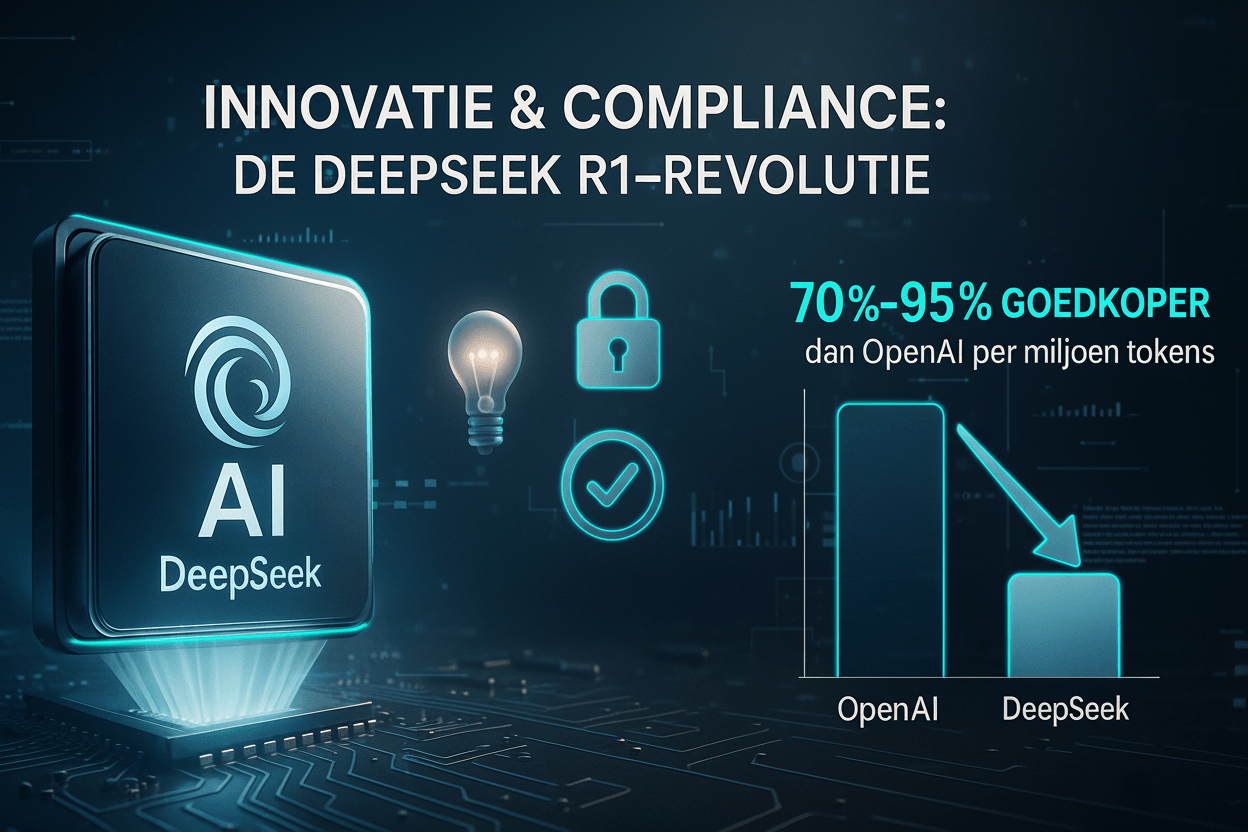
Where companies pay approximately $15 per million input tokens at OpenAI and $60 for output, DeepSeek charges only ~$0.55 and ~$2.19 per million tokens respectively (source). A price reduction of 70% to more than 95%. Organizations thus achieve comparable performance at a fraction of the price -- without compromising on speed, scalability, or context (source).
DeepSeek's Technical Innovation: Hybrid Learning Approach
Traditional AI systems rely primarily on supervised fine-tuning (learning from example material), but DeepSeek R1 introduces a reinforcement learning (RL) architecture. The model thus learns largely independently through rewards for correct solutions -- ideal for complex, innovation-driven problems.
However, 100% RL proved detrimental to language purity and readability in practice. DeepSeek R1 now uses a hybrid approach by combining supervised fine-tuning with RL. The result: creative and usable AI responses (source).
Privacy, Data Governance and Compliance: The Discussion Around Chinese AI
Cheaper and more powerful -- but how safe is using DeepSeek for organizations operating within European legislation (GDPR)?
- So far, DeepSeek has shown little transparency regarding data governance. As of September 2025, there are no public reports on data processing, privacy protection, or independence from the Chinese government (source).
- Privacy researchers and compliance specialists advise thorough 'due diligence', especially with sensitive data (source).
Practical advice: Evaluate AI models not only on price and performance, but especially on compliance and privacy. Always use Data Protection Impact Assessments (DPIAs) and choose partners that apply privacy-by-design.
DeepSeek R1 Compared to OpenAI and ChatGPT
OpenAI's GPT models were long the benchmark in terms of user-friendliness and performance. DeepSeek R1 offers comparable mathematical and logical reasoning at very low costs and via an open-source entry point.
Nevertheless, OpenAI remains the standard in terms of transparency and compliance, partly thanks to continuous audits and clear statements about data processing (source).
Opportunities and Risks: Action Items for Dutch Organizations
- Leverage open-source innovation: R1's accessibility makes AI deployment possible, even for SMEs or organizations with specific customization needs.
- Be vigilant about compliance and privacy: Check whether external parties comply with GDPR and work with privacy-by-design partners.
- Create flexibility in AI architectures: Build systems that can quickly switch models and prevent lock-in risks.
- Invest in education and change management: Invest in understanding of how AI works, its risks, and best practices for AI adoption.
Ready to transform your organization with AI?
Discover how we can help you with AI workflow automation.
Get in Touch