
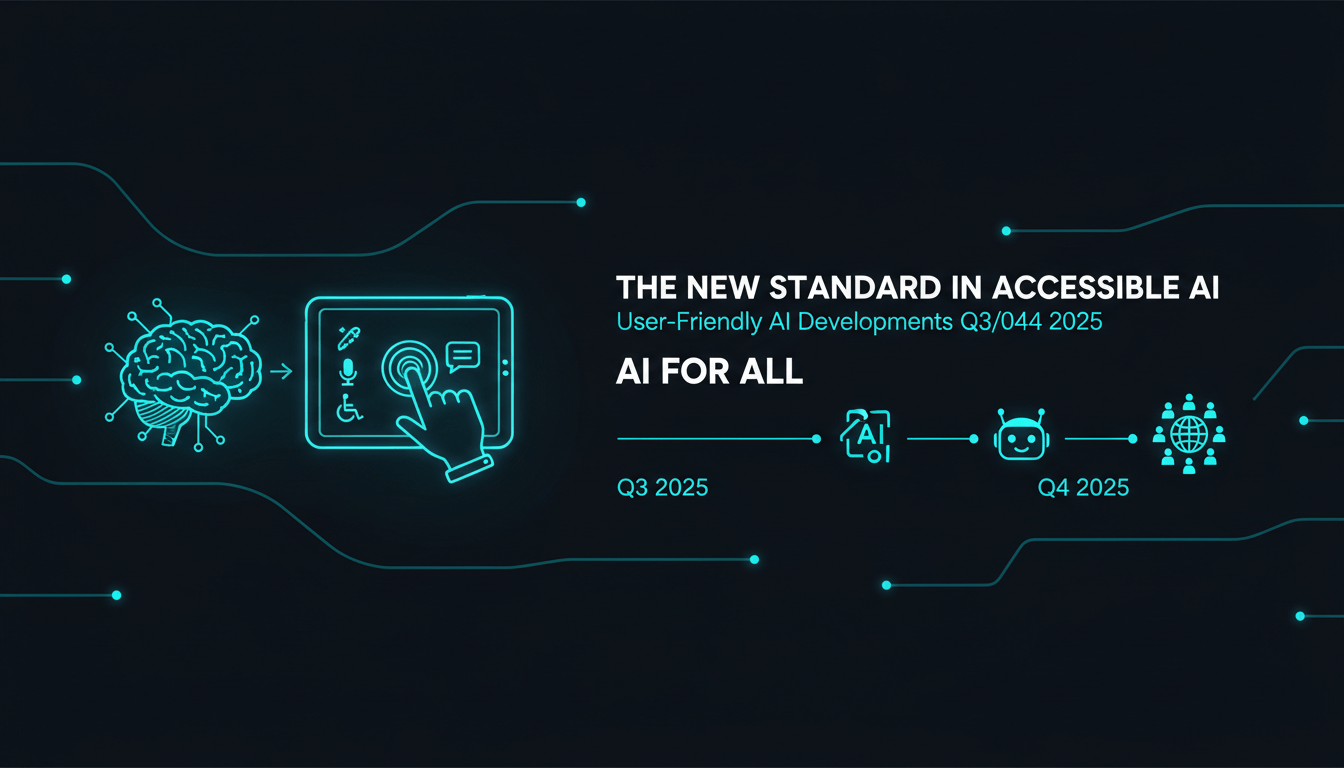
The new standard in user-friendly AI: Developments in Q3 2025 and what Q4 brings
Estimated reading time: 7 minutes
Key insights
-
AI is more accessible and user-friendly than ever, driving exponential growth in adoption and impact within organizations.
-
Autonomous AI agents and multimodal systems are becoming regular "colleagues" in daily work processes.
-
Edge AI and transparency place privacy and speed at the center in industries including manufacturing, healthcare and finance.
-
Concrete AI applications accelerate efficiency, customer retention and decision-making, regardless of technical background.
-
The focus in Q4 shifts to pragmatic implementation, agentic AI and open source solutions.
Table of Contents
-
How user-friendliness accelerates AI adoption within organizations
-
Practical Applications: AI as the Engine of Daily Efficiency
How user-friendliness accelerates AI adoption within organizations
Over the past quarters, the world of artificial intelligence has undergone a true transformation. Where AI was long considered complex and technical, one key concept now dominates: user-friendliness. With this shift, the technology is no longer at the center, but rather people and their daily practice. For professionals making decisions about digital transformation, this development is essential: only when AI is truly easy to deploy does it become a driving force behind efficiency, innovation and workplace satisfaction.
In this blog, we dive deep into the key developments of Q3 2025, present inspiring practical examples and offer a preview of Q4. We conclude with concrete tools for quickly and efficiently implementing user-friendly AI – fully in line with the AI consultancy and workflow automation in which our organization excels.
Q3 2025: AI as a Seamless Part of Work and Life
The third quarter of 2025 marked a clearer-than-ever evolution: AI was no longer discussed as future music, but as an indispensable part of daily business operations. No less than 45% of all board discussions within companies were about the deployment of AI.
Autonomous AI Agents as New Colleagues
The biggest breakthrough was the rise of autonomous AI agents. These systems are much more than intelligent chatbots; they independently schedule meetings, conduct basic negotiations with suppliers and execute diverse tasks without human intervention. Through their adaptive capability and continuous optimization, they have truly become user-friendly: they understand context, adapt to user preferences and deliver cost savings and efficiency – with an increase in autonomous business operations of as much as 50% compared to last year. Source
For organizations with a remote-first strategy, a growing trend, these AI assistants are crucial: more than 60% plan to broadly deploy such systems before the end of 2025.
Conversational AI: From Bot to Human Interaction
Through recent developments in natural language processing, chatbots and voicebots can now recognize not only language, but also tone, emotion and sentiment. The result: customers and employees no longer experience assistance as a "talking FAQ", but as a natural, human interaction. This has led to savings of up to 30% on support costs, while satisfaction actually increases. Source The global chatbot market is now worth over 27 million dollars, and continues to grow at a rapid pace. Source
Multimodal AI: Talking, Seeing, Listening
AI systems now think, see and hear. Where previously only text was the leading input, there are now systems that understand images, video and audio. This allows employees to share and retrieve information as they are accustomed to – via image, audio or text – without barriers or complex manuals. Source
Practical Applications: AI as the Engine of Daily Efficiency
Workplace Integration: Less Administration, More Focus
Modern AI assistants, think of tools like Microsoft Copilot and Google Duet AI, take over routine tasks: managing calendars, transcribing meetings, document analysis or even programming. Result: employees need to spend less time on time-consuming administration and have more room for tactical and creative work. The short implementation time and smooth integration with existing systems make adoption low-barrier.
Retail: Ultimate Personalization and Retention
In retail, AI delivers hyper-personalized customer experiences through smart analysis of purchasing behavior, browsing history and real-time interaction. The result: a 15% increase in customer retention, better customer support and streamlined pricing strategies. Everything revolves around accessibility: both customers and employees benefit from direct, relevant suggestions. Source
Data-Driven Decision-Making for Everyone
Predictive AI analysis is no longer the domain of data scientists, but accessible to every decision-maker. Analysis tools take over routine calculations, enabling decision-making that is on average 40% faster and more accurate. Source
Edge AI: Speed and Privacy Hand in Hand
New are the so-called Edge AI systems. Think of applications like Apple Intelligence, which run AI locally – that is, on the device itself, without a cloud connection. This means less latency, maximum privacy and the ability for real-time decisions. Especially in manufacturing, automotive and IoT, there is enormous growth potential here.
Transparent and Responsible AI
The massive adoption of AI brings responsibility. Organizations are investing heavily in frameworks for responsible AI, with attention to privacy, explainability and the prevention of bias. Tools are being built to audit AI decisions and ensure transparency in sensitive sectors such as healthcare and finance.
Outlook Q4 2025: From Technology to Application
What can we expect in the coming quarter?
-
Realistic Implementation – More and more companies are moving from pilots and hype to concrete, pragmatic implementation of AI solutions that truly deliver value within existing processes.
-
Deepening of Agentic AI – AI agents are becoming smarter: they gain better memory, can reason more complexly and work ever more autonomously. This means even less manual work and a larger range of tasks that can be automated. Source
-
Open Source AI on the Rise – For organizations seeking maximum control and flexibility, open source AI models are gaining ground. With these, you determine the pace and direction yourself.
-
Breakthrough in Healthcare and Fintech – In healthcare, easy-to-use diagnostic AI tools are expected. In the financial sector as well, AI-powered platforms are increasingly helping small businesses and even consumers with accessible predictions and analyses. Source
-
Quantum Computing & AI – Although still nascent, the integration between quantum computing and AI opens the doors to extremely powerful models. User-friendly interfaces will make the difference in adoption beyond the research world.
Practical Takeaways for Decision-Makers
-
Put the user at the center: Successful AI adoption starts with tools that are intuitive. Involve employees early in the selection and implementation process.
-
Automate step by step: Start small, for example by automating one workflow (think of email processing via n8n). Scale up once the benefits are clear.
-
Invest in training: Invest not only in technology, but especially in training teams and emphasize change management.
-
Choose flexible and scalable: Open source and modular solutions (like n8n workflows) guarantee that you can move with future developments.
Ready to transform your organization with AI?
Discover how we can help you with AI workflow automation.
Get in Touch