



Estimated reading time: 9 minutes
Key points:
- AI value falls into three categories: personal productivity, autonomous experiments, and AI inside your processes. Each has its own yardstick.
- Personal productivity (a Copilot licence per employee) is a cost, not a business model. What you measure there is time saved per person, not return on the balance sheet.
- Autonomous AI experiments that set out to overturn a whole business model behave like venture capital: nine out of ten fail, and the single breakthrough has to pay for the rest.
- The real profit sits in AI inside a repeatable process that runs hundreds of times a month. That is where return is measurable and scalable.
- At Bolsenbroek, AI in the valuation process saved more than 1,000 hours in the first year, measured.
Table of contents
- The three places where AI costs or earns money
- Personal productivity: useful, but not a return
- Autonomous experiments: venture capital, not a budget line
- AI in your processes: this is where the money is
- Optimise or redesign
- How to find your own profit spot
- How we help
- Frequently asked questions
- Sources
You handed out the licences, people are enthusiastic, and yet at the end of the quarter there is nothing extra on the balance sheet. That is not a sign that AI does not work. It is a sign that the profit is being looked for in the wrong place.
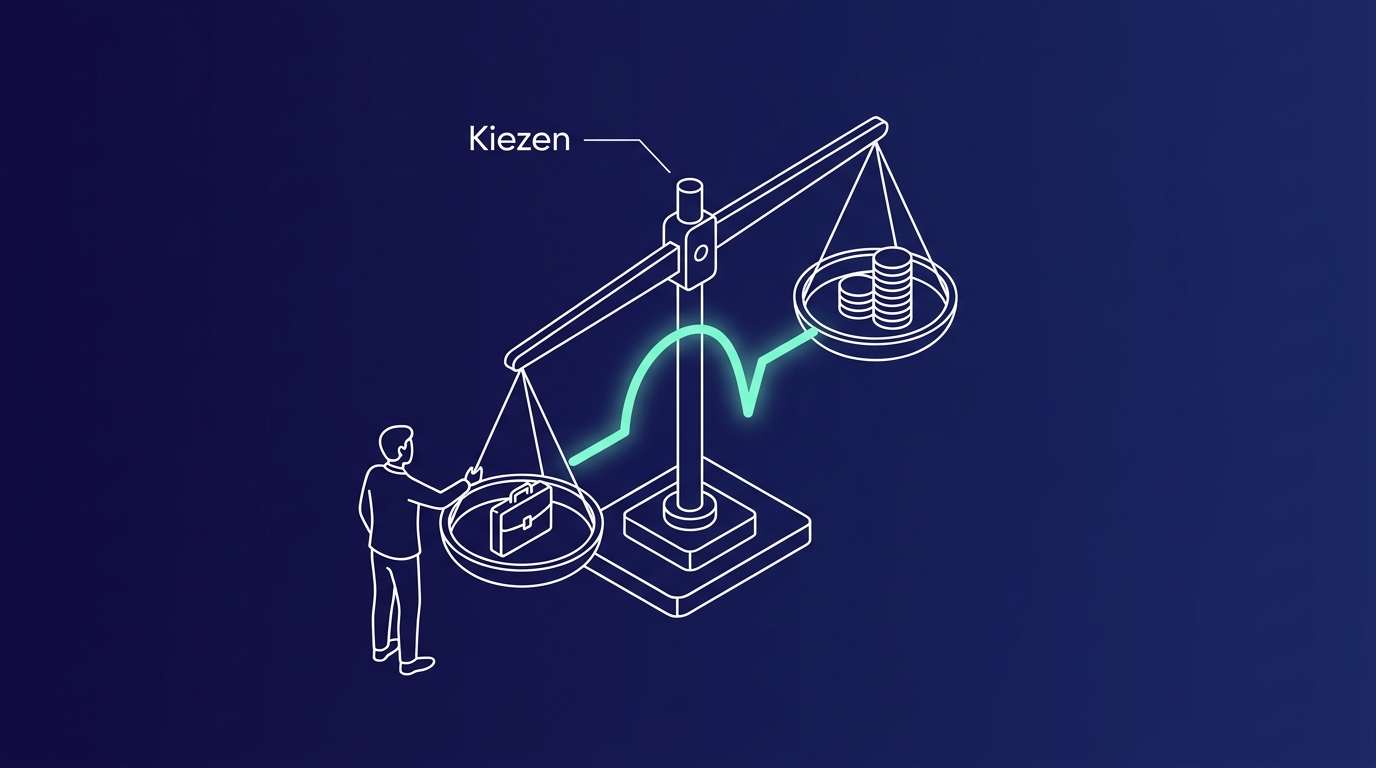
AI value shows up in three places in an organisation, and each of the three asks for a different approach and a different yardstick. Mix them up and you end up measuring return in a place where it was never going to appear. This article explains the three places, shows where the money actually is, and gives you a way to find your own profit spot.
The inspiration for this piece comes from Joop Snijder's podcast AIToday Live (episode S08E68), including the Gartner figures discussed there. The practical numbers come from our own work.
The three places where AI costs or earns money
Put your AI efforts side by side and three groups appear that have nothing to do with each other, apart from all being called "AI".
The first group is personal productivity: individual employees using an AI assistant to write email, summarise, or code faster. The second group is the big experiment: an autonomous system meant to take over part of your service or business model. The third group is AI built into an existing process that runs every day.
They share the word, not the logic. Lump them together and ask "what is AI earning us", and you get an answer that means nothing, because the three answer that question in completely different ways.
Personal productivity: useful, but not a return
The most common first step is a licence per employee. Everyone gets an assistant, everyone can get going. That is useful, and still you do not see it back in the numbers. That is correct, and it is how it should be.
Gartner has a separate term for it: Return on Employee. The benefit lands with the individual employee, not on the balance sheet. Compare it to a good coffee machine: nice for the team, and nobody expects the coffee to pay for itself in revenue.
There is something else at play. Personal productivity scales badly, because the gain differs per person and per task. One person writes twice as fast, another barely faster. For most organisations this step brings you level with competitors doing the same thing. Useful for keeping up, not an advantage.
The mistake is not the licence itself. The mistake is expecting a balance-sheet return from it. Measure time saved and satisfaction here, and look for your revenue somewhere else.

Autonomous experiments: venture capital, not a budget line
At the other end of the spectrum sits the ambitious experiment: an agent that independently takes over a whole process or business unit. This is where the exciting demos come from, and where most of the disappointment is created.
The right comparison is venture capital. An investor knows that nine out of ten holdings will disappoint and that the one outlier has to carry the entire fund. Budget your AI experiments that way and you are prepared. Expect every experiment to succeed and you will be disappointed by your own expectation, not by the technology.
This category has every right to exist, as long as you treat it that way: a portfolio with room to fail, not a project with a hard payback date. Set aside a budget you can afford to lose, and do not count your winnings from the demo.
AI in your processes: this is where the money is
Then the third place, and according to Gartner the place where by far the most AI value appears: AI built into an existing, repeatable process. Something that happens hundreds of times a month and costs time every single time.
An example from the podcast makes it concrete. A customer request took 4 hours by hand. With AI in it, that drops to 1.5 hours. At 300 requests a month that is 750 hours saved, every month again. Because the process is repeatable, so is the gain. Here you simply measure Return on Investment: hours, lead time, revenue you can take on as a result.
It works the same way in our own practice. At vehicle valuation firm Bolsenbroek, AI sits inside the valuation process, an action that repeats every working day. In the first year that saved more than 1,000 hours. That is a measured number from a running process, not a projection from a demo. Exactly the category where Gartner says the value belongs.
The difference with the first two places: you do not have to hope the return appears. You can calculate it before you start, and measure it once you are done.
Optimise or redesign
Inside those processes sits another choice that decides how big the gain gets. You can speed up an existing process, or you can lay it out again now that AI can do part of it.
Speeding up delivers immediate results: the same steps, less time. Redesigning delivers more, because you remove steps that only existed because a human had to do them. A request that used to pass five people can, with AI in it, perhaps pass one. That is a different kind of gain than ten percent faster.
The practical trade-off: start by speeding up to build confidence and numbers, then dare to put the process itself up for discussion. The biggest savings are almost never in the first step.

How to find your own profit spot
Back to your own organisation. Take your top three AI initiatives right now and put them in the right category. Is it personal productivity, an experiment, or AI in a process? Are you measuring them with the right yardstick?
Usually two out of three turn out to sit in the first category, where you should not expect a return, and the third category where the money is turns out to be missing. That is not bad news. It means the profit is still there for the taking, in a process you already run hundreds of times a month.
The question is not "which AI tool do we buy". The question is "which repeatable process costs us the most time right now, and what would it deliver if AI did part of it". That is a business question, not a tool question.
How we help
At And AI we start with that business question, not with a tool. We work from knowledge to advice to custom build: first understand where you stand and where the gain is, and only then build.
A good starting point is our free AI scan. In a few minutes you see which stage of AI maturity your organisation is in, where the next opportunity lies, and what a logical next step looks like. Not a tool you have to buy, but a view of where return is there for you to take.
If you want to talk further about a specific process after that, we will think along in a no-obligation conversation. The AI scan gives the direction, the conversation makes it concrete.
Take the free AI scan Book a no-obligation call
Frequently asked questions
Why is AI delivering so little in our company?
You are probably measuring personal productivity: separate assistants for employees. Those are useful, but by definition they do not produce a return on the balance sheet. The profit sits in AI inside a repeatable process. Move the question there and a measurable result does appear.
How do you calculate the ROI of AI?
Pick a process that recurs often, measure how much time or lead time a step costs now, and how much after deploying AI. Multiply by the number of times per month. That gives you a number you can map back onto revenue or capacity. A feeling about time is not ROI, output is.
Does a Copilot licence earn money?
Not on its own, and that is not a problem. It is a provision for your employees, comparable to good tools. Measure satisfaction and time saved per person there, and expect the revenue somewhere else.
Where do you start if you do want a return?
With one repeatable process that costs a lot of time right now. Start small, measure the result, and expand if it works. The free AI scan helps you work out which process delivers the most for you.
Sources
- AIToday Live, S08E68, "Waar levert AI echt geld op in je organisatie" (Joop Snijder). The three-category model and the worked example come from this episode.
- AIToday Live, S08E52, "Gartner AI-voorspellingen 2027, wat klopt ervan?". Supports the point that productivity gains are often booked but stay invisible on the balance sheet.
- AI-onderzoek 2026, Info Support (July 2026), conducted with Markteffect among 400 Dutch IT decision-makers. From it: 92 percent use AI daily, but only 23 percent have actually integrated AI into standard tools or workflows.
- Bolsenbroek figures: And AI's own project work, see the case study.


Want to apply this in your own organization?
In a no-obligation conversation we look at which tasks take up most of your team's time, and whether AI can safely take them over or speed them up. We respond within 24 hours.
Book an intro call